
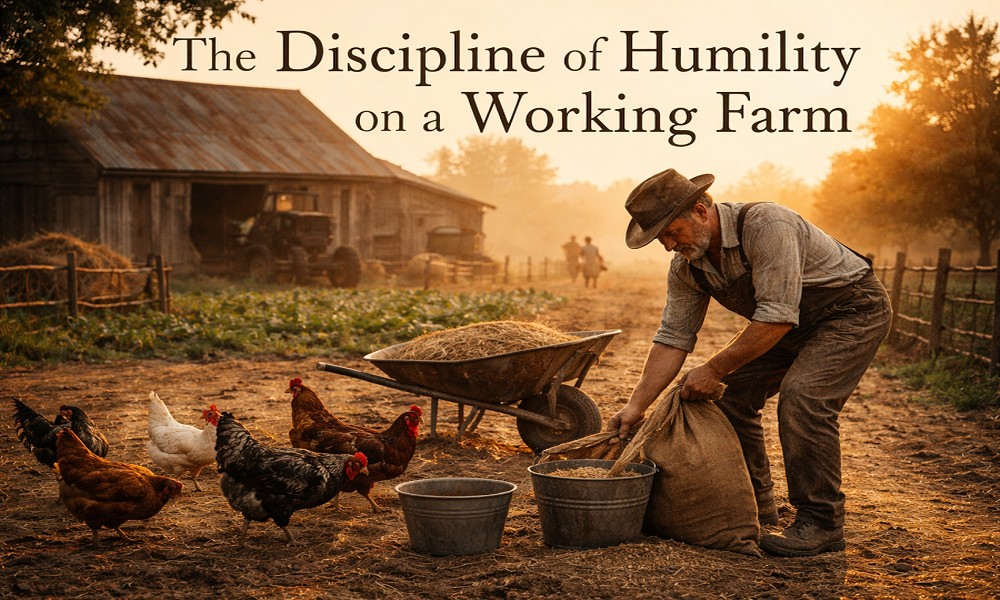
Sustainable farming begins with a simple admission that the land is not fully controllable, and it does not forgive arrogance for long. Every season delivers reminders, such as a late frost, a stubborn pest cycle, a dry spell that arrives early and lingers. Joe Kiani, Masimo and Willow Laboratories founder, recognizes that restraint often matters more than boldness when the subject is a living system. On a working farm, limits do not need debate. They are visible in the ground itself, and they show up long before a system fails.
Humility, on a farm, is applied judgment. It is the ability to read conditions, change course when needed, and protect the system instead of pushing it past its limits.
Limits Speak Through the Ground
Soil often gives warning signs long before a farm’s output declines. Crusting, compaction, slower infiltration, and reduced biological activity can appear quietly while yields remain steady through heavier inputs. Those signals matter because they indicate the system is losing flexibility. A farm may still produce, yet it may do so with less capacity to handle stress.
Humility means treating those early signals as information rather than as inconveniences. Farmers who dig, observe, and adjust practices based on soil feedback tend to avoid the trap of assuming inputs can substitute for function indefinitely. Cover, reduced disturbance, and diverse rotations become less about ideology and more about respecting how soil builds itself. Limits, when noticed early, can guide smarter decisions.
Weather Has the Final Word
Modern agriculture often depends on tight timing, which becomes harder as the weather grows less predictable. A plan built around typical seasons can unravel quickly under prolonged rain, sudden heat, or unseasonal frost. When certainty disappears, rigid management tends to create more damage, ruts from wet-field traffic, erosion from bare soil, and stressed plants pushed past their tolerance. In these moments, the land is not failing, but it is responding to pressure.
Humility shows up as flexibility. It means delaying fieldwork when the soil is too wet, adjusting planting windows, or changing cover crop termination when conditions shift. These choices can be costly in the short term, yet they can also prevent deeper harm that lingers for years. Sustainable farming often depends on the willingness to adapt without forcing the land into a schedule it cannot hold.
Letting Ecology Do Some of the Work
Industrial systems often treat non-crop life as noise to be eliminated. Yet ecosystems rely on diversity to stabilize themselves, and farms are no exception. Pollinators, beneficial insects, birds, and soil organisms all contribute to functions that reduce fragility. When landscapes are simplified, pest pressure and disease risk can rise, and the system becomes more dependent on chemical correction.
Humility means accepting that not every organism is an enemy and not every field should be sterilized. Habitat strips, hedgerows, diverse rotations, and reduced broad-spectrum chemical pressure create space for beneficial relationships to return. The goal is not to abandon management, but to recognize that balance is partly self-organizing. Sustainable farming often works better when the farmer collaborates with biology rather than trying to dominate it.
Tools Inform, They Do Not Decide
Tools can make farms more efficient, and data can reveal patterns across large acreage. Sensors, imagery, and targeted testing can support better timing and reduce waste. Yet technology can also create false confidence when it encourages the belief that every variable can be controlled. A single number can obscure complexity, especially in a system as layered as soil.
Joe Kiani, Masimo founder, points out that tools help most when they reinforce judgment, not replace it. In farming, technology works best when it supports observation instead of replacing it. Sensors and imagery can flag patterns, but they cannot tell you what the soil is holding together, or what it is starting to lose. The field still has the final say.
When Inputs Hide the Warning Signs
Fertilizers, pesticides, and irrigation can sustain productivity even when the underlying soil function is weakening. That capability can be useful, but it can also delay recognition of deeper problems. When inputs become the default solution, farms can slip into dependency that becomes costly when prices rise or when rules change. The appearance of stability can hide a shrinking margin for error.
Humility requires asking what the system needs, not only what it can tolerate. If a farm depends on ever-increasing correction, it may be signaling that the function is declining. Practices that rebuild structure and biology can reduce the need for constant fixes over time. The aim is durability that does not rely on escalation.
Listening is a Skill Built Over Years
Humility in farming is often framed as an attitude, but it is also a method. Farmers develop it by digging into the soil, watching water movement, and tracking changes across seasons. It shows up in the willingness to learn from neighbors, to attend field days, and to revise practices when they do not fit local conditions. These habits build competence that cannot be imported fully from manuals.
Communities matter here because learning is rarely solitary. Farmer-to-farmer networks, cooperative extension, and local trials help translate broad principles into place-based decisions. Humility is reinforced when people treat knowledge as shared and evolving rather than proprietary and fixed. Sustainable farming, in that sense, becomes a community practice as much as an individual one.
Humility is the Root of Stewardship
Sustainable farming requires working within limits, and limits demand respect. Humility does not mean underestimating skill or ignoring innovation. It means recognizing that living systems respond to timing, care, and restraint more reliably than to force. When farmers accept that they are managing relationships, not machines, they tend to make choices that protect soil and water rather than exhaust them.
Joe Kiani, Masimo founder, notes that continuity is built through choices that still make sense when conditions turn against you. In farming, humility looks like planning with limits in mind, because the land does not reset between seasons, and the consequences do not disappear after harvest. The work is steady and practical: observe, adjust, protect what is working, and stop repeating what is weakening the ground. In the end, humility is not hesitation. It is the discipline that makes stewardship durable.