
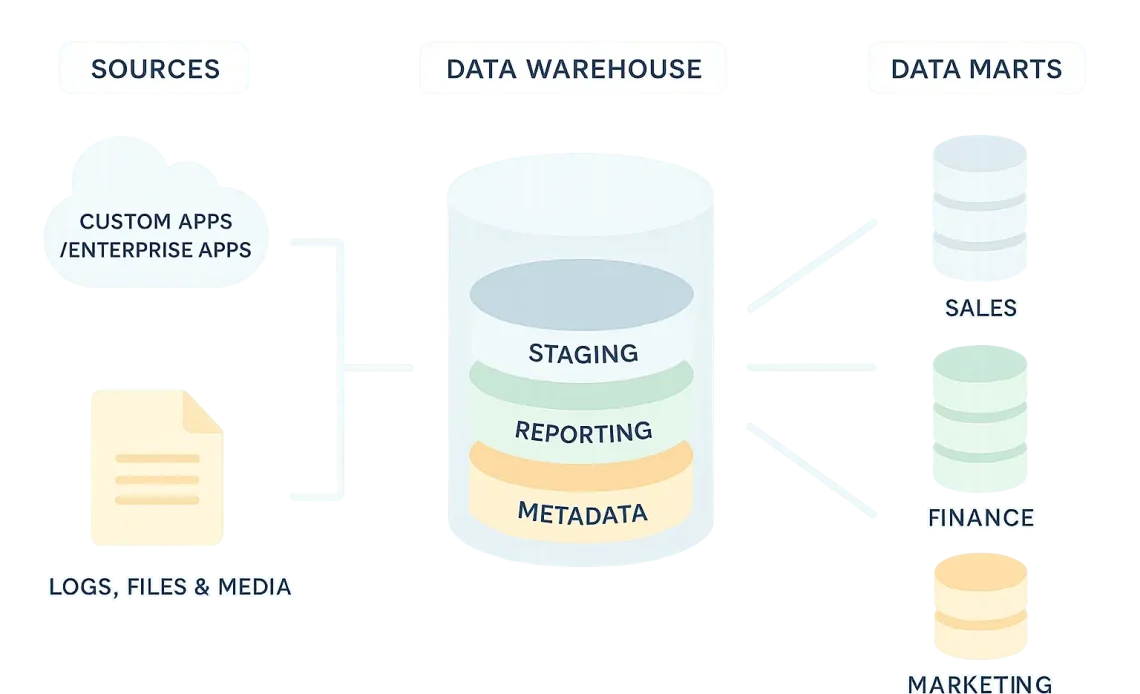
What Is a Data Warehouse is a common question in business intelligence and analytics. A data warehouse is a centralised database designed specifically for analysis and reporting, not for running day-to-day operations. Think of it as a company’s memory: it stores historical data from sales systems, customer platforms, marketing tools, and finance software in one place, organized so questions like “how did revenue trend over the past three years by region?” can be answered quickly.
The simplest analogy: your company’s transactional systems (CRM, ERP, website) are like the tills and stockrooms of a shop – they handle the action as it happens. A data warehouse is like the accountant’s filing room, where everything that happened has been recorded, organised, and made available for review. You do not run sales through the filing room. You go there to understand what happened and make better decisions going forward.
Data Warehouse vs Database vs Data Lake
These three terms are used interchangeably and incorrectly in most organisations. They are genuinely different things:
| Feature | Operational Database | Data Warehouse | Data Lake |
|---|---|---|---|
| Primary Purpose | Run the business (transactions) | Analyse the business (reporting) | Store everything (exploration) |
| Data Type | Current state only | Historical, structured | Any type (raw, structured, unstructured) |
| Query Style | Fast individual lookups | Complex aggregations, joins | Flexible; often exploratory |
| Data Structure | Highly normalised (3NF) | Denormalised (star/snowflake schema) | Schema-on-read (structure applied later) |
| Users | Applications, operational staff | Analysts, executives, BI tools | Data scientists, engineers |
| Write Frequency | Continuously (every transaction) | Batch loads (daily/hourly) | Continuous or batch |
| Example Tools | PostgreSQL, MySQL, Oracle | Snowflake, BigQuery, Redshift | AWS S3, Azure Data Lake, Databricks |
How Data Gets Into a Warehouse: ETL vs ELT
ETL (Extract, Transform, Load) – the traditional approach: Data is extracted from source systems, transformed (cleaned, standardised, reshaped) in a staging area, then loaded into the warehouse in its final form. Transformation happens before the data enters the warehouse.
ELT (Extract, Load, Transform) – the modern cloud approach: Raw data is loaded directly into the warehouse first, then transformed using the warehouse’s own processing power. Modern cloud warehouses (Snowflake, BigQuery) are powerful enough to handle transformation after loading, which makes this faster and more flexible.
The shift to ELT has been accelerated by tools like dbt (data build tool), which allows analysts to write SQL transformations that run inside the warehouse itself – without needing a separate transformation server.
A Real-World Example: End to End
Imagine a mid-sized e-commerce company with three separate systems: a Shopify store, a Klaviyo email marketing platform, and a Google Ads account. Each holds data the other does not see.
- Every night, an automated pipeline extracts yesterday’s data from all three sources.
- The data is cleaned (null values handled, currencies standardised, duplicate customers merged) and loaded into the warehouse – for example, Snowflake.
- Inside the warehouse, dbt transformations build a unified ‘customer’ table that combines purchase history from Shopify, email engagement from Klaviyo, and acquisition source from Google Ads.
- A business analyst opens Tableau, connects to the warehouse, and builds a dashboard showing customer lifetime value by acquisition channel.
- The marketing team sees that customers acquired through branded search have 40% higher LTV than those from generic ads. They shift budget accordingly.
None of that analysis was possible when the data lived in three separate tools. The warehouse made it possible.
Who Uses a Data Warehouse?
| Role / Team | How They Use It | Example Question They Answer |
|---|---|---|
| Business Analysts | SQL queries, BI tool dashboards | ‘What was our best-selling category in Q3 by region?’ |
| Data Scientists | Pull training datasets for ML models | ‘Which customers are most likely to churn in the next 30 days?’ |
| Finance Teams | Revenue reconciliation, forecasting | ‘How does this month’s revenue compare to the same month last year?’ |
| Product Teams | User behaviour and funnel analysis | ‘Where in the onboarding flow are users dropping off?’ |
| Executives / Leadership | KPI dashboards, board reporting | ‘Are we on track to hit annual targets across all business units?’ |
| Marketing Teams | Campaign attribution, audience segmentation | ‘Which channel drove the highest ROI customers last quarter?’ |
Popular Data Warehouse Tools in 2025
| Tool | Type | Best For | Cost Model |
|---|---|---|---|
| Snowflake | Cloud (multi-cloud) | Enterprise, complex workloads, data sharing | Pay per compute + storage |
| Google BigQuery | Cloud (GCP) | Google ecosystem, serverless analytics | Pay per query or flat rate |
| Amazon Redshift | Cloud (AWS) | AWS-heavy organisations | Reserved instance or serverless |
| Azure Synapse Analytics | Cloud (Azure) | Microsoft / Power BI heavy teams | Pay per use |
| Databricks Lakehouse | Cloud (multi-cloud) | ML + analytics combined, data science teams | Pay per compute unit |
| dbt Core | Transformation layer (free) | SQL-based data modelling on any warehouse | Free (open source) |
| PostgreSQL | Self-hosted | Small teams, budget constraints, full control | Infrastructure cost only |
When You Do NOT Need a Data Warehouse
A data warehouse is infrastructure investment, and it is genuinely not the right tool for every organisation.
- Under 10 employees with simple reporting needs: a well-structured spreadsheet connected to your source tools via Zapier or native integrations is sufficient and far cheaper.
- Single-source data: if your entire business runs on one platform (e.g., Shopify only), that platform’s built-in analytics cover most needs.
- No data team: a warehouse without someone to build and maintain the pipelines and transformations delivers no value. The tool is only as useful as the people using it.
- Pre-product stage: warehouses are for understanding patterns in data you have already collected. If you are still validating whether anyone wants your product, analytics infrastructure is premature.
5 Signs Your Business Is Ready for a Data Warehouse
- You have data in more than two or three separate tools and regularly need to cross-reference them manually.
- Someone on your team spends significant time exporting CSVs from different platforms and stitching them together in Excel.
- Business decisions are being delayed because the data needed to make them is not accessible quickly.
- You have hired or are planning to hire a data analyst or data scientist whose productivity depends on clean, accessible data.
- Your company processes enough transactions that manual analysis has become unreliable or prohibitively slow.
When multiple signs apply simultaneously, the return on a warehouse investment becomes clear quickly. The cost of a modern cloud warehouse at small-to-medium scale is often $200-$1,000 per month – a fraction of what an analyst’s time costs when they are manually reconciling spreadsheets instead of building insight.