
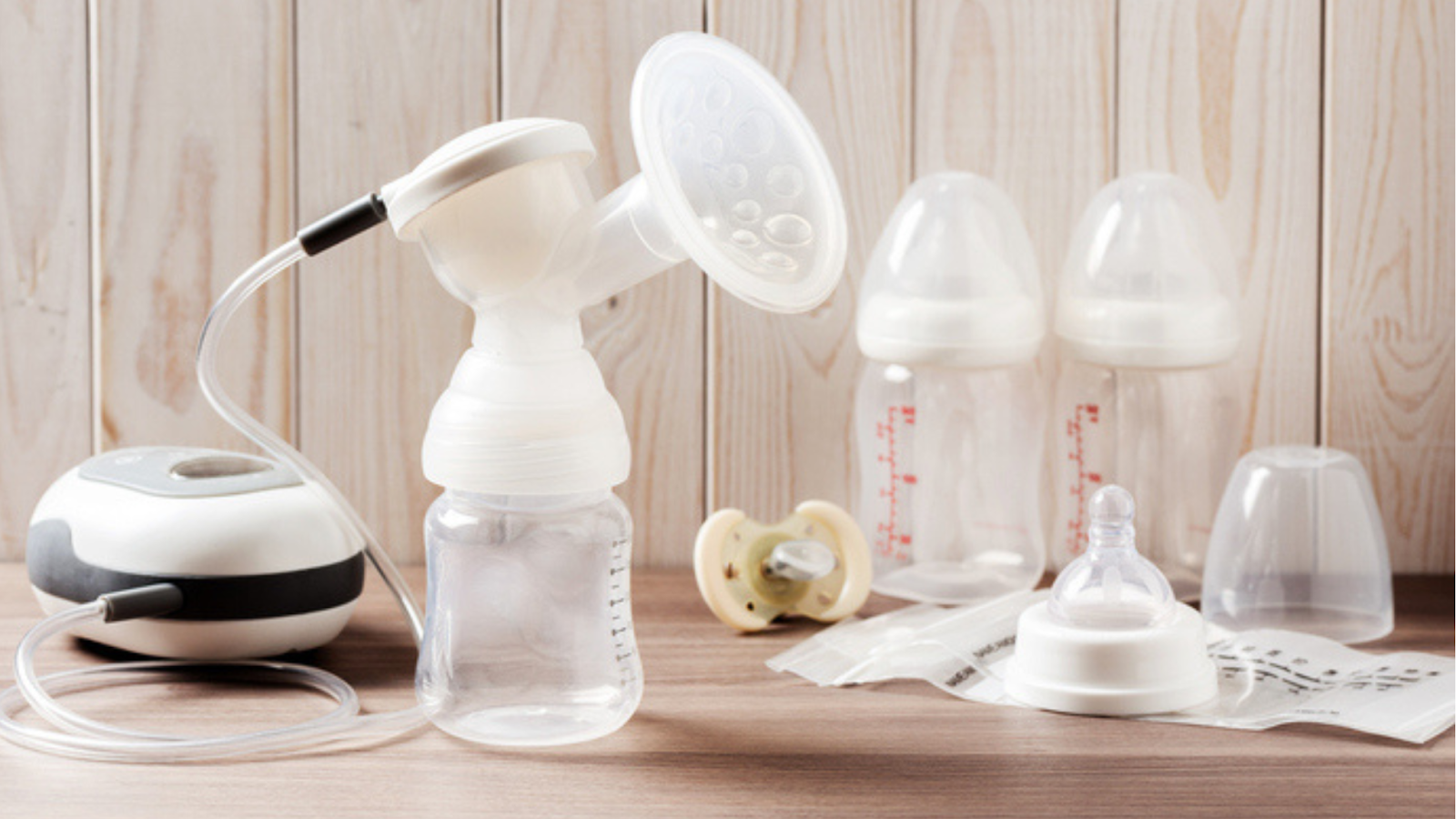
If your baby is staying in the hospital and you need to express breast milk for several weeks or months, you will need a hospital-grade electric breast pump. These pumps are made with a closed system. This means your breast milk will not enter the machine, keeping it clean and safe. Because of the closed system and built-in filter, the same pump can be used by more than one person without the risk of mixing milk.
There are many types of electric breast pumps. One common brand used at Nationwide Children’s Hospital and in NICUs they manage is the Medela Symphony®.
Your health insurance may cover the cost of renting an electric breast pump. You will need a prescription. For help with renting a pump, you can call the lactation team at Nationwide Children’s Hospital at 614-722-5228 or the lactation staff at the hospital where your baby is staying.
When to Start Using the Pump
Start pumping as soon as possible. Try to pump 8 times each day, with no more than a 5 to 6 hour break during the night for sleep. If you wake up during the night, it is best to pump then too. (For more details on breast care, refer to Helping Hand HH-IV-61 Breast Care and Expressing Milk.)
How to Use an Electric Breast Pump
Before using the pump, take time to learn about the different parts (Picture 1).
A nurse or a member of the lactation team will show you how to use the pump properly. The outside of the pump should be wiped with aseptic wipes before and after each use. After wiping down the pump:
- Wash your hands well with soap and water for 15 seconds.
- Put all the pump parts together.
- Place the breast shield over each nipple (Picture 2).
- Turn the pump on and adjust it to the highest level that is still comfortable.
- Pump both breasts at the same time for 15 to 20 minutes.
- Pumping should not be painful. If you feel pain, contact the lactation team for help.
Storing and Using Expressed Breast Milk Safely
- Pour the expressed milk into sterile containers provided by the hospital.
- Use a new container each time you pump.
- Never add fresh milk to milk that is already stored.
All containers must be labeled with:
- Your baby’s full name
- The date and time the milk was collected
- Your baby’s medical record number
- Any medicines the mother took in the past 24 hours
Store your milk based on the plan made with your health provider. You can refrigerate or freeze the milk. For more guidance, see Helping Hand HH-IV-61 Breast Care and Expressing Milk.
- Expressed milk can be kept in the refrigerator for up to 48 hours.
- It can be frozen for 3 months in a regular freezer or 12 months in a deep freezer.
- When bringing milk to the hospital, pack it in a cooler with freezer packs.
- Bring only cold or frozen milk. Do not thaw the milk ahead of time.
- Give the milk to a hospital staff member when you arrive so they can store it properly.
- Do not refreeze milk after it has been thawed.
- Any milk left in the bottle after feeding must be thrown away.
When your baby goes home, you may combine milk from different pumping sessions into one bottle, but only if the milk is the same temperature. For instructions on thawing and combining milk, refer to Helping Hand HH-IV-61 Breast Care and Expressing Milk.
Taking Care of the Pump and Pump Parts
To keep your baby safe, always use clean equipment. Before and after each use, wipe the outside of the pump with aseptic wipes.
- Always wear nonsterile gloves when handling the wipes to protect your skin.
- After cleaning the pump, let it dry for 3 minutes to allow the wipes to work properly.
- All pump parts that touch milk (breast shield, connector, valve, membrane, container, and lid) must be washed after each use.
If your baby is in an ICU, NICU, CTICU, PICU, Special Care Nursery, or has a weak immune system, you’ll need to clean the parts more carefully.
Steps to Clean Pump Parts:
- Wash your hands with warm, soapy water.
- Take apart the pump pieces and separate the collection bottles.
- Set aside parts that don’t need cleaning (such as tubing, membrane cap, and protective membrane) unless they touched milk (see Picture 1, parts 6, 7, and 8). If they did, tell your nurse or lactation consultant.
- Put the parts to be washed in a hospital-provided basin.
- Use liquid dish soap—avoid scented soaps or those with lotion, alcohol, or additives, which can enter the milk.
- Wash the pump parts and bottles with soap and water, then rinse well.
- If your baby is in the ICU or has a weak immune system, use only sterile water to wash and rinse.
- If your baby is in another area of the hospital, you can use hot tap water at the hospital or at home.
- Do not use well water to wash or rinse parts.
After cleaning the parts:
- Wash the basin with dish soap and water. Use sterile water if your baby is in the ICU or similar unit.
- Let all parts and bottles air dry on clean paper towels.
Sterilizing Pump Equipment
Pump parts that touch milk need to be sterilized once every 24 hours. Before sterilizing, always wash and rinse the parts using the steps above.
Choose one of these ways to sterilize:
- Use a Medela Quick Clean™ Micro-Steam bag
- Follow the instructions on the package.
- In the hospital, use the bag only once.
- At home, the bag can be used up to 20 times.
- Use a dishwasher
- Place pump parts on the hot water cycle with dishes.
- Boil the parts
- Boil in fast-moving water for 10 minutes.
- Do not use well water.
Let the parts dry on clean paper towels. You can bring the clean, dry parts to the hospital in a clean plastic food container or Ziploc® bag.