
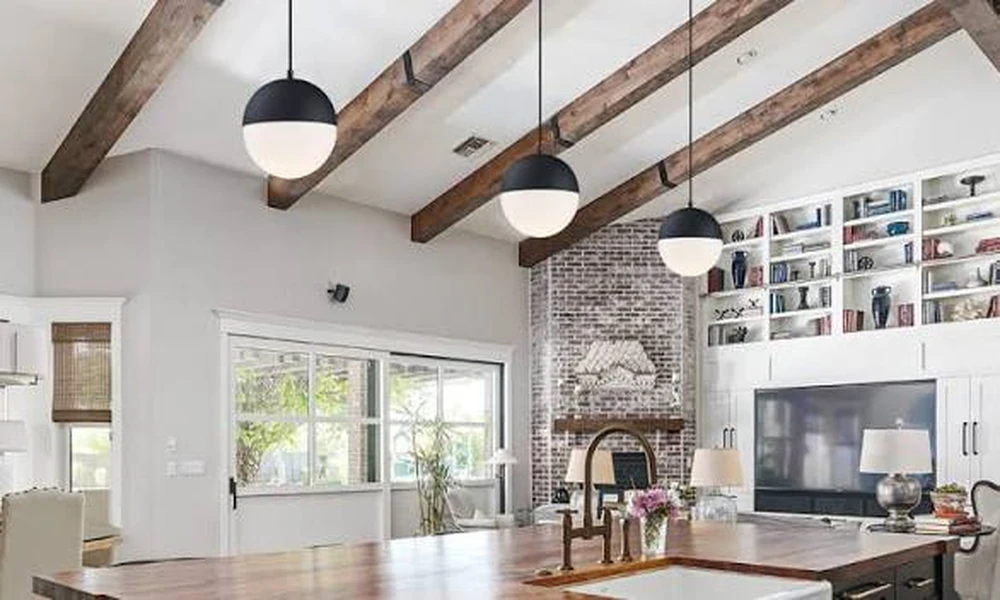
Why Your Island Lighting Falls Short
Kitchens have become the busiest room in most homes, serving as cooking space, homework station, and gathering point for guests. Many kitchen islands still rely on a single overhead fixture chosen years ago, often before the island became the room’s focal point. This mismatch shows up as glare during food prep, shadows across the counter, or lighting that feels harsh at dinner but too dim for reading recipes. The problem rarely gets solved because homeowners assume the fix requires an electrician and a full renovation. In reality, the fixture itself is usually the bottleneck.
A single flush-mount light or a dated chandelier was never designed for the layered demands of a modern island. Task lighting, ambient lighting, and accent lighting all compete for the same socket, and something has to give. The result is a space that photographs poorly and performs worse, with cooks squinting at cutting boards while the rest of the kitchen sits in shadow. Ceiling height, island length, and cabinet finishes all affect how light behaves in this specific spot, yet these factors are frequently ignored when a fixture is chosen off a showroom floor. Fixing the visual problem without addressing function tends to create a second problem down the line.
Creating a Dedicated Lighting Zone
Addressing the issue starts with treating the island as its own lighting zone rather than an extension of general room lighting. This means selecting fixtures based on the island’s dimensions, the height of the ceiling above it, and the tasks that happen there daily. Guidance on choosing pendant lights for your kitchen island typically recommends measuring the island’s length and dividing it to determine how many pendants are needed and how far apart they should hang. Two or three coordinated fixtures usually outperform one oversized piece, since spacing allows light to spread evenly across the counter instead of pooling in the center.
Once spacing is worked out, the next step is deciding on mounting height and bulb temperature. Pendants hung too high wash out the counter, while pendants hung too low block sightlines across the kitchen and can bump against tall guests. A gap of roughly thirty inches between the bottom of the fixture and the countertop tends to work in most kitchens with standard eight or nine foot ceilings, though taller ceilings call for adjustment. Warmer bulb temperatures, generally in the 2700 to 3000 kelvin range, tend to suit food preparation and casual dining without making the space feel clinical.
Essential Features That Reduce Glare
Shopping for island pendants gets easier once a few criteria are settled ahead of time. Glass or metal shades that direct light downward tend to reduce glare on countertops better than open bulb designs, which can be harsh at eye level when someone is seated at the island. Dimmable fixtures offer flexibility between bright task lighting for chopping vegetables and softer light for evening conversation. Finish matters too, since brushed brass, matte black, and polished nickel all read differently against various cabinet and countertop combinations, and a mismatch can make an otherwise well-planned fixture look out of place.
Energy use deserves attention alongside style, particularly since island lights are often left on for hours at a stretch. LED options draw a fraction of the electricity that older incandescent or halogen bulbs required, and they generate far less heat, which matters when pendants hang close to where people are cooking. Checking ENERGY STAR lighting guidance before buying can clarify which bulbs and fixtures meet efficiency standards without sacrificing brightness or color quality. Fixtures with clear wattage and lumen information on the packaging make comparison shopping simpler, especially when trying to match the output of a fixture already in use elsewhere in the kitchen. Taking the time to compare a few options before installation usually costs less than replacing a fixture that turns out to be the wrong fit.